
More Employers Plan to Hire MBAs in 2026, and AI Fluency Is Now the Baseline
| 4 Min Read

Employer expectations for MBA graduates are shifting as AI becomes part of everyday business work. Hiring teams are adjusting what they look for in management and leadership candidates. For professionals preparing for MBA-level roles, understanding those expectations can clarify which skills matter most. To capture that perspective, a questionnaire conducted on behalf of Concordia University, St. Paul (CSP Global) surveyed 500 managers involved in MBA hiring decisions.
This questionnaire aimed to reveal how employers plan to hire and evaluate MBA talent in 2026. The findings highlight where demand is expected to grow, which skills employers now treat as baseline and where recent MBA hires often fall short. For current and prospective MBA students, the results offer a view of how employer expectations are changing and what that means for career readiness.
Key Takeaways
- More than one-third of employers (37%) expect to increase MBA hiring in 2026.
- 47% of employers pay MBA hires a 5-9% salary premium, while 33% offer a premium of 10% or more.
- The top hiring priorities for 2026 are AI fluency (35%), the ability to quantify business impact (31%) and a portfolio of applied work (25%).
- Nearly one in four employers (22%) say AI proficiency is now a baseline expectation for MBA-level roles, not a differentiator.
- The most noticeable skill gaps among recent MBA hires are people leadership and coaching (30%) and proficiency in AI tools (23%).
Where MBA Graduates Are in Demand
Demand for MBA graduates varies across roles or industries. Employers shared where they expect to expand MBA hiring in 2026 and how strongly the degree influences compensation and job requirements.
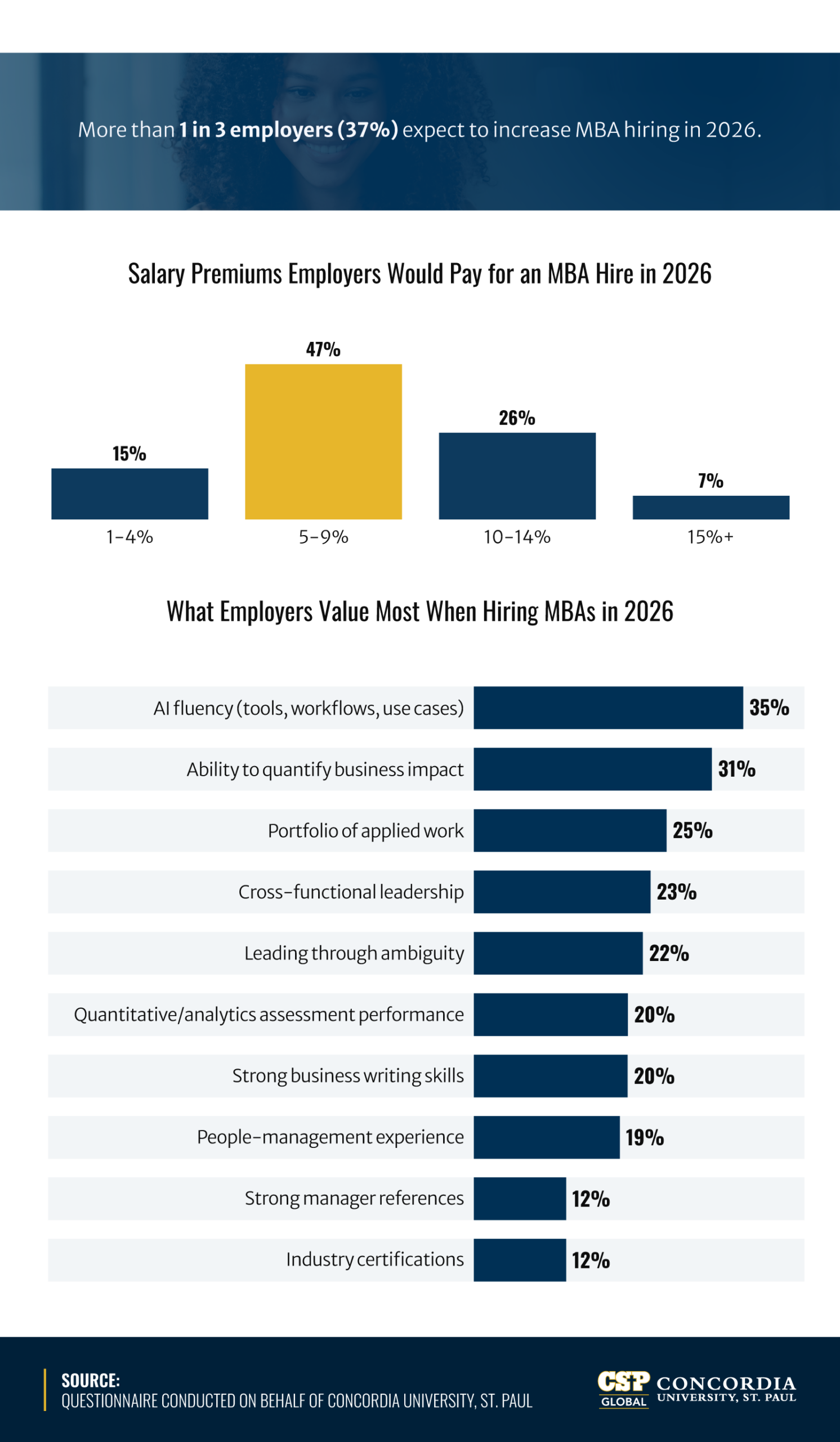
More than one in three employers (37%) expect to increase MBA hiring in 2026. When considering a candidate, employers said they place the most value on AI fluency (35%), the ability to quantify business impact (31%) and a portfolio of applied work (25%).
Compensation for MBA qualifications is often tied to a salary premium. About half of employers (47%) reported paying MBA candidates a 5-9% premium, while 33% offered a 10% or more premium.
Managers in these industries are the most likely to increase MBA hiring in 2026:
- Tech
- Education
- Healthcare
- Professional and business services
- Finance
Those most likely to offer a salary premium work in these industries:
- Tech
- Healthcare
- Finance
- Education
- Hospitality
Job postings pointed to similar expectations. In 2026, 44% of employers said an MBA would be preferred in job listings either often (28%) or almost always (16%). Fewer employers said an MBA would be required, though more than one in four said it would be required often (15%) or almost always (11%). MBAs are most likely to be required in professional and business services (including consulting), healthcare, tech, finance, and education.
What Employers Expect MBA Graduates to Bring to the Workplace
Employers define MBA readiness in practical terms tied to everyday work. Strong candidates can show how they add value through results, not only describe what they learned in class. For MBA students, this places greater emphasis on applied skills and real-world experience.
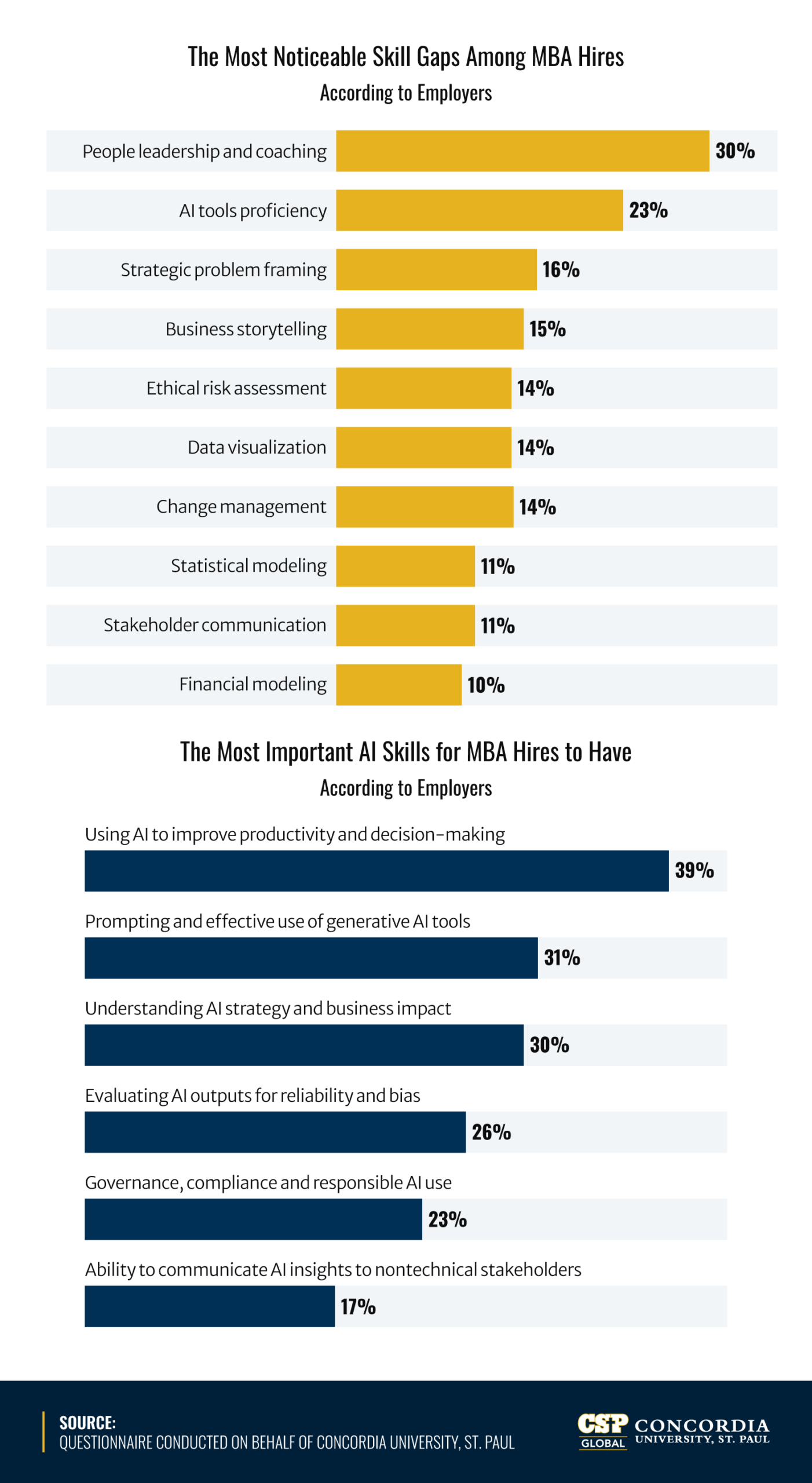
Nearly one in four employers (22%) said AI proficiency is now a basic expectation for most MBA-level roles. Several skills have also grown in importance over the past year, led by strategic thinking and problem solving (45%). Other priorities include:
- AI fluency focused on responsible and effective use (39%)
- Using AI to improve productivity and decision-making (39%)
- Data literacy tied to interpreting and analyzing data (37%)
- Communication skills, such as writing and presentations (32%)
Employers also identified gaps among recent MBA hires. The most common were people leadership and coaching (30%) and hands-on experience with AI tools (23%). These gaps point to areas where students may benefit from additional practice before stepping into management roles.
MBA program structure also influences how employers assess readiness. Integrated ethics, governance and risk instruction most often signals job readiness (31%), followed by:
- Communication-intensive coursework focused on writing and presentations (29%)
- Experiential client projects across courses (28%)
- Cross-functional capstones with measurable outcomes (27%)
- Leadership labs with structured feedback and coaching (24%)
How MBA Students Can Apply These Findings
Current and prospective MBA students can use these insights to make more intentional choices about their education and skill development. Employers increasingly expect graduates to arrive with practical AI fluency, the ability to measure business impact and foundational people leadership skills.
Students should seek programs and coursework that emphasize applied projects, leadership coaching and responsible use of AI tools. Focusing on these areas can help ensure they meet baseline expectations while remaining competitive in MBA-level hiring.
Methodology
A questionnaire of 500 hiring managers was conducted on behalf of CSP Global to explore which MBA-taught skills, specializations and program structures employers will value most in 2026. Respondents were sourced using CloudResearch Connect. The average age of respondents was 33; 50% were women, 49% were men and 1% were nonbinary. This is a non-scientific, exploratory questionnaire designed to explore behavioral and attitudinal trends. It is not intended to represent all hiring managers.
About Concordia University, St. Paul
Concordia University, St. Paul offers online programs designed for working adults who want flexible options that fit around career and family responsibilities. Students can explore a wide range of academic pathways, including business programs that support skill development for leadership roles. Professionals interested in building employer-aligned skills can explore CSP Global’s online Master of Business Administration (MBA) program.
Fair Use Statement
You may use the information in this article for noncommercial purposes only. If you share it, please include proper attribution and a link back to Concordia University, St. Paul.