The Promotion Plateau Report
4 Min Read

Career growth has become harder to predict as automation, leaner organizational structures and economic uncertainty all impact the workplace. Many professionals are finding that experience alone no longer guarantees advancement, especially as new skills and credentials are becoming increasingly important across industries.
A questionnaire conducted on behalf of Concordia University, St. Paul (CSP Global) surveyed American professionals to learn more about career stagnation, workplace pressures and their interest in continuing education. The questionnaire aimed to better understand what may be pushing working adults to rethink their next step.
The findings point to a workforce experiencing burnout, changing skill demands and limited advancement opportunities, while also considering education as a way to regain momentum. Career uncertainty is influencing both professional goals and interest in flexible online learning.
Key Takeaways
- 59% of American professionals say AI is changing the skills needed in their field, yet only 14% have actually experienced AI replacing their tasks.
- 30% of American professionals say burnout prompted them to reconsider their career direction, outpacing layoffs (12%) by 2.5 to one.
- 45% of American professionals feel they have hit a ceiling in their current role, rising to 52% among Gen X.
- 77% of American professionals say they would be more likely to pursue education if their employer helped pay for it, making tuition support one of the most powerful levers for workforce development and retention.
- 55% American professionals say they are likely to pursue a professional credential within the next two years, with leadership training and AI literacy topping the list of most in-demand skills.
Career Stagnation Affects Professionals Across Industries and Generations
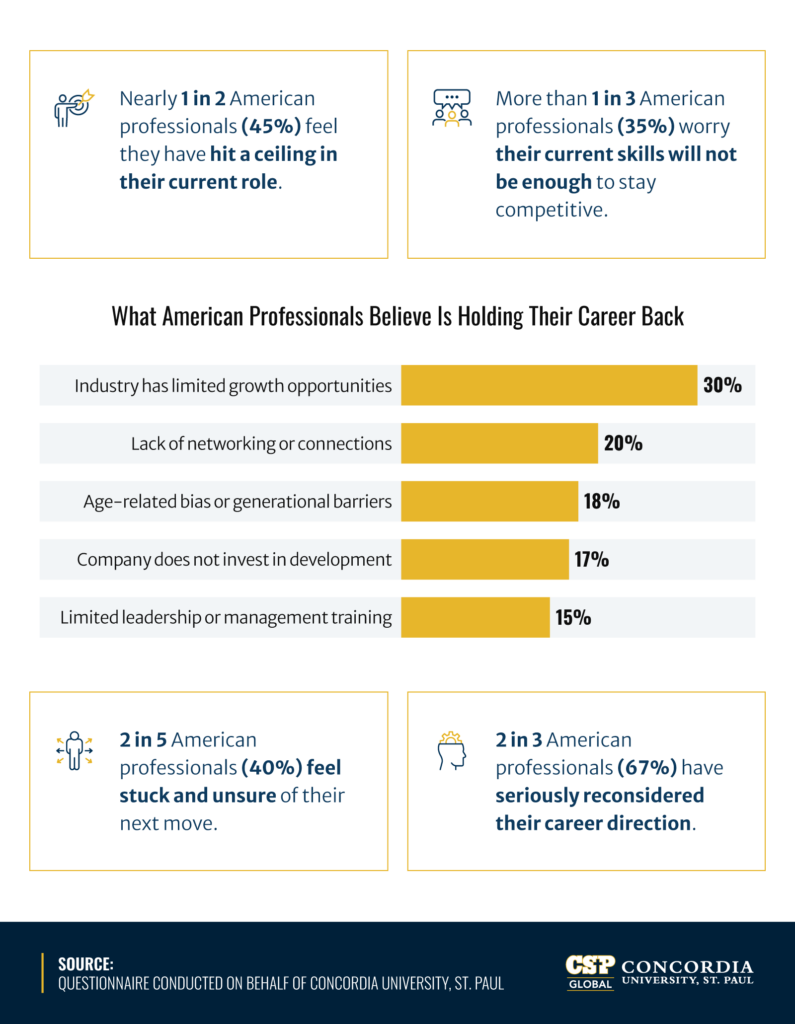
- 54% of manufacturing professionals report hitting a career ceiling, the highest rate of any industry.
- 45% of technology/IT professionals worry their skills are not enough to stay competitive, 10 points above the national average of 35%.
- 20% of technology/IT professionals report that AI or automation has replaced tasks they previously performed, compared to just 9% of education professionals.
- 35% of professionals feel more replaceable at work than they did a few years ago, rising to 38% among Gen X professionals.
- 27% of Gen X professionals regret not pursuing a graduate degree or credential sooner, the highest rate of any generation.
- 36% of Gen Z professionals say not building a stronger professional network is their biggest career regret, the highest among generations.
Professionals See Education as a Way to Stay Competitive
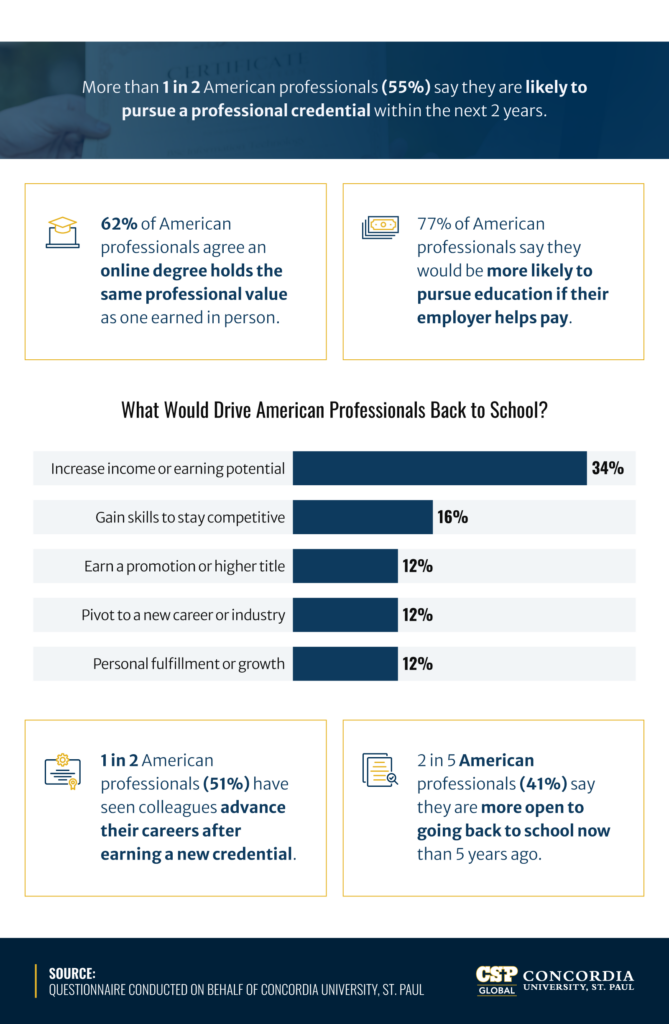
- 74% of technology/IT professionals agree that AI is changing the skills needed in their field, the highest rate across all industries.
- 61% of healthcare professionals say they are likely to pursue additional education, the highest rate of any industry.
- 69% of healthcare professionals agree that an online degree holds equal professional value to one earned in person, the highest rate of any industry.
- 55% of retail/e-commerce professionals say their employer offers no education benefits at all, more than double the rate of technology/IT professionals (24%).
- 62% of millennial professionals say they would need a 20%+ salary increase within two years to justify additional education, the highest expectation of any generation.
Gen Z Shows the Strongest Interest in Credentials and Graduate Education
- 69% of Gen Z professionals say they are likely to pursue a professional credential within the next two years, compared to 46% of Gen X professionals.
- 63% of Gen Z professionals agree that going back to school mid-career is worth the investment, compared to 52% of Gen X professionals.
- 44% of Gen Z professionals express interest in an MBA or graduate degree program, the highest rate among generations.
Methodology
A questionnaire of 1,008 working American professionals was conducted on behalf of Concordia University, St. Paul to explore how professionals view their career trajectory, what they believe is holding them back, and how likely they are to pursue additional education or credentials to regain momentum. Topics included career satisfaction, workplace disruptions, skills gaps, career regrets, attitudes toward education and motivations for returning to school. Respondents were sourced using CloudResearch Connect.
The average age of respondents was 40; 51% were men, 47% were women and 1% were nonbinary. In addition, 57% were millennials, 25% were Gen X, 14% were Gen Z and 4% were baby boomers. Baby boomers were excluded from generational breakdowns because they comprised less than 5% of respondents. Some percentages in this study may not total 100% due to rounding. This is a non-scientific, exploratory questionnaire designed to explore behavioral and attitudinal trends. It is not intended to represent all workers.
About Concordia University, St. Paul
Concordia University, St. Paul offers online degree programs designed for working adults who want flexible options that fit around career and family responsibilities. Learners can explore a wide range of academic pathways, including business programs that support skill development for leadership roles. Professionals interested in building their skills can explore CSP Global’s online MBA program today.
Fair Use Statement
You may use the information in this article for noncommercial purposes only. If you share it, please include proper attribution and a link back to Concordia University, St. Paul.