
The Creator MBA: Are Side Hustles the New Business School?
| 7 Min Read

Graduate business education is evolving as more professionals look for flexible, practical ways to advance their careers while managing financial pressures. Many Master of Business Administration (MBA) students are no longer waiting until graduation to apply what they learn. Instead, they are building income streams and testing ideas in real time. A questionnaire conducted on behalf of Concordia University, St. Paul (CSP Global) surveyed 643 U.S. adults who are either currently enrolled in an MBA program or planning to apply within the next year, including 220 active MBA students.
This research explored how today’s MBA students are combining graduate education with hands-on career building. The results show that many are using side hustles, real-world projects and flexible credentials to make their education feel more immediate and useful. Rather than treating business school as something separate from work, they are weaving it into the way they earn, build skills and create new opportunities for themselves.
Key Takeaways
- 79% of MBA students currently run a side hustle or independent business.
- 43% of MBA students currently side hustling say their primary motivation is funding tuition or living costs, not building a post-graduation empire, reframing the side hustle as a financial survival strategy as much as an entrepreneurial one.
- 66% of MBA students have used or adapted a class assignment for a real-world pitch, post or product at least once, collapsing the wall between the classroom and the marketplace.
- 81% of MBA students say they would choose the same format or credential again.
- 69% of enrolled students would choose a stackable MBA paired with industry certifications or micro-credentials over a standalone degree, signaling a demand for programs that prove job-ready skills, not just classroom time.
Working While Earning an MBA
Balancing coursework with real-world business activity has become a defining feature of the modern MBA experience. Students are increasingly blending academic progress with entrepreneurial experimentation, creating new pathways for both income and skill development.
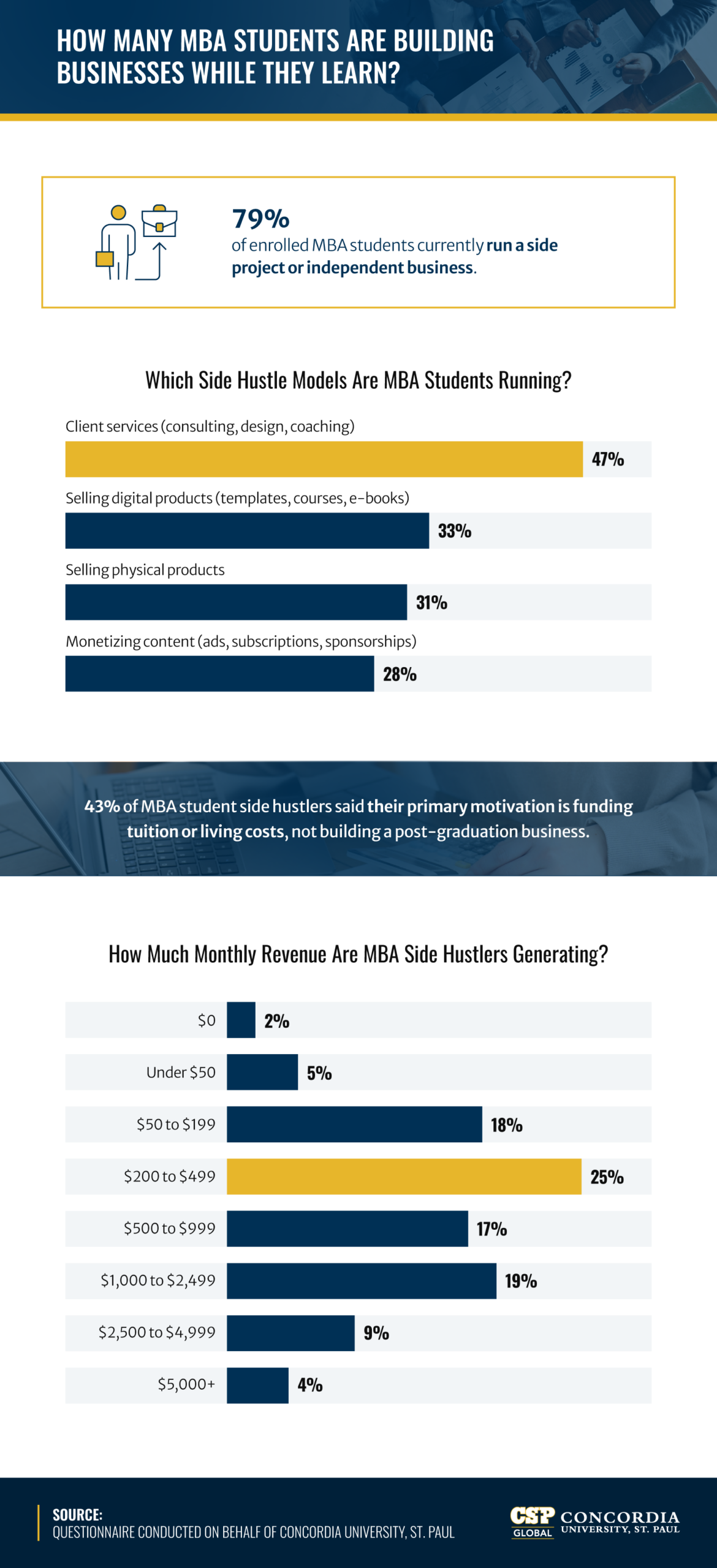
A majority of enrolled MBA students reported active engagement in side ventures: 79% were running a side project or independent business, and 14% planned to start one within the next 12 months. This level of participation signals that entrepreneurial activity is no longer a niche pursuit but a mainstream component of the MBA journey. Among those with side hustles, client services emerged as the most common model at 47%, followed by:
- Digital products (33%)
- Physical products (31%)
- Content monetization (28%)
These models reflect a mix of low-barrier entry points and scalable opportunities that align with skills developed in business programs.
Financial necessity played a leading role in participation, with 43% of MBA student side hustlers citing tuition or living expenses as their primary motivation. Fewer students were side hustling to build a business for after graduation (21%) or to simply explore entrepreneurship (14%).
About one-third of student entrepreneurs (32%) reported earning $1,000 or more per month from their side hustle, including 4% who earned $5,000 or more. Another 25% made between $200 and $499 monthly, indicating steady but early-stage growth for many ventures.
Despite high entrepreneurial activity, traditional career goals remain influential. Thirty-four percent of MBA students viewed their degree primarily as a path to advancing within their current company, slightly ahead of the combined 33% pursuing entrepreneurial paths. This group included those planning to launch a business after graduation (24%) and those using the degree to scale an existing venture (9%).
Generational differences also emerged, with Gen X enrolled students showing the highest entrepreneurial orientation of any generation at 42%, compared to 31% of millennials and 30% of Gen Z. This suggests that Gen X students are more likely to view the MBA as a tool for launching or scaling a business.
The MBA Students Turning Coursework Into Revenue
Coursework is producing tangible outputs that extend beyond the classroom. Students are building portfolios that demonstrate applied skills while simultaneously contributing to real business outcomes.
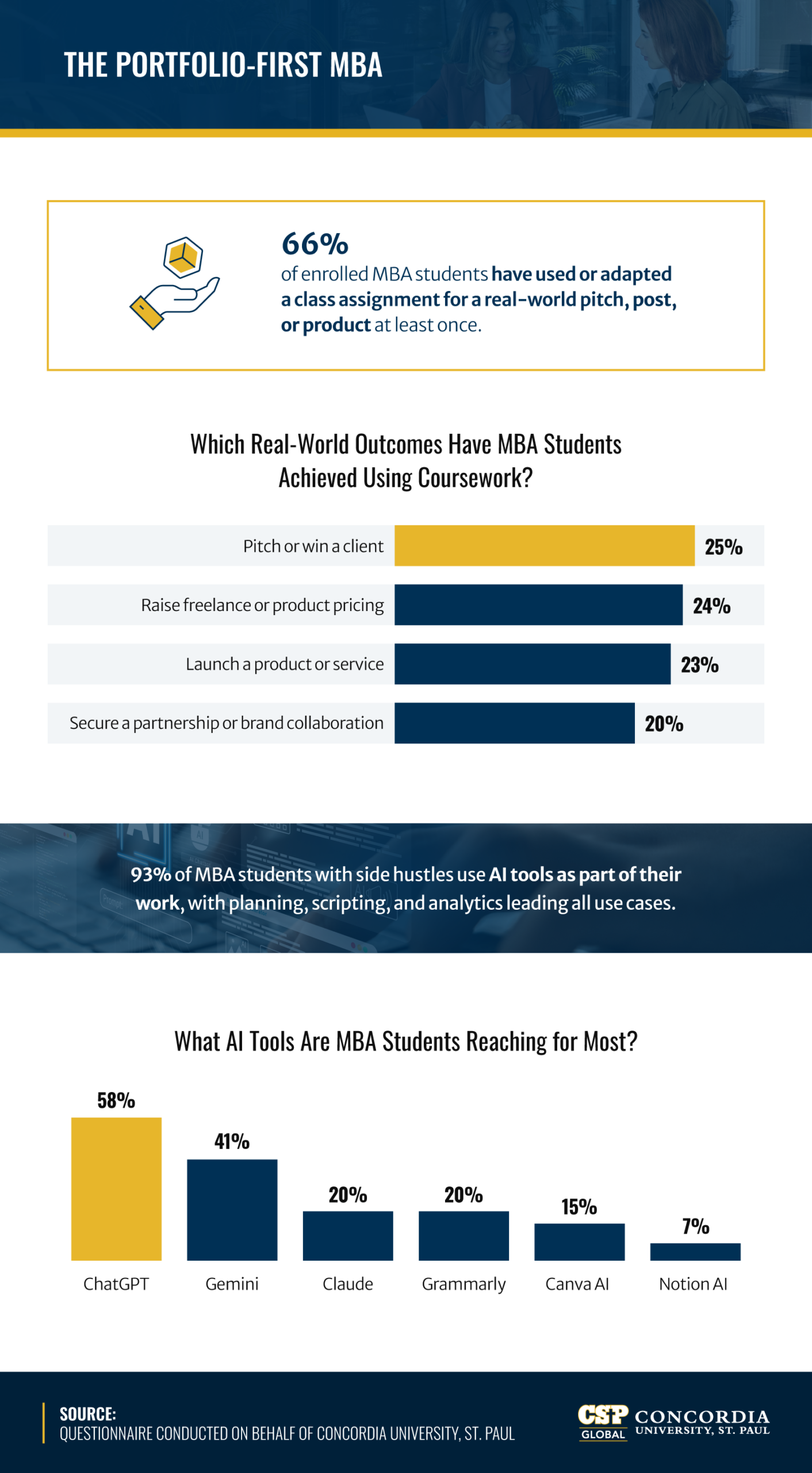
Many MBA students reported applying their academic work directly to real-world scenarios: 66% used or adapted a class assignment at least once, and 10% did so frequently. The most common deliverables included:
- Digital strategy documents and pitch decks (38%)
- Branding strategies (35%)
- Social media or campaign plans (30%)
These align closely with current business needs, making them immediately useful in professional and entrepreneurial settings. More than half of enrolled students (55%) used these things to achieve measurable outcomes, including:
- Pitching or winning clients (25%)
- Raising pricing (24%)
- Launching products or services (23%)
- Securing partnerships (20%)
Financial impact was also notable, as 57% of students reported that a single class project generated at least $100 in value, while 10% achieved $1,000 or more.
At the same time, AI adoption was nearly universal among student entrepreneurs, at 93%. ChatGPT led with 58% usage, followed by Gemini (41%). Student entrepreneurs said they most often use AI tools in their work for:
- Planning (57%)
- Content creation (56%)
- Analytics review (47%)
Credentials also contributed to business growth. One in four students reported that certifications or badges helped them gain clients or increase pricing. These findings reinforce the value of portfolio-driven and skills-based learning in modern MBA programs.
What MBA Students Actually Want From Their Degree
Today’s MBA students are placing greater emphasis on measurable returns and flexible program structures. Preferences are shifting toward models that combine traditional education with practical credentials and real-world outcomes.
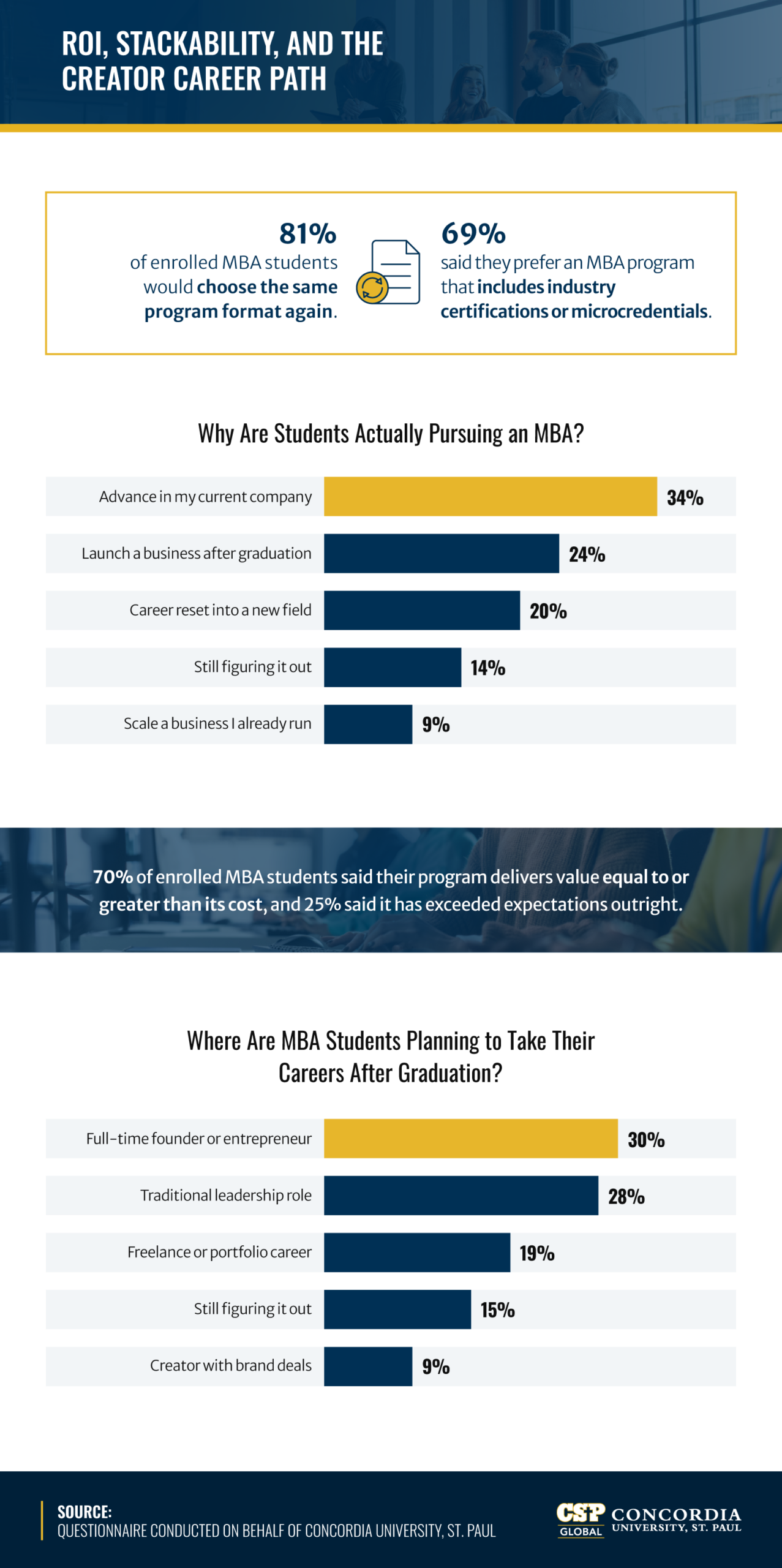
Most enrolled MBA students reported positive perceptions of program value, with 70% stating that their degree delivered equal or greater value than its cost and 25% saying it exceeded expectations. Satisfaction remained strong, as 81% indicated they would choose the same format or credential again.
Demand for flexible program design was clear, with 69% of students preferring a stackable MBA that includes certifications or microcredentials. Interest was even higher among millennials (72%) and remained strong among Gen Z (69%).
Students also identified specific features they want to see in future programs. The most requested addition was a side hustle incubator or build-with-me lab (18%), followed by:
- Credit for freelance or business work (16%)
- Personal brand courses (13%)
- Portfolio-based graduation materials (13%)
Overall, 40% of respondents said MBA program costs were the single biggest barrier to applying sooner. Another 26% pointed to family or caregiving responsibilities, while 23% reported limited time as a key challenge.
Career goals among enrolled students reflected a growing departure from traditional paths:
- 30% aim to become full-time founders.
- 28% are pursuing leadership roles.
- 19% are building freelance or portfolio careers.
- 9% plan to enter creator-based roles.
Combined, nearly six in 10 students have planned non-traditional career paths, highlighting the expanding definition of MBA success.
The Bottom Line for Prospective MBA Students
The students in this survey are not waiting for graduation to start building. They are pitching clients, launching products and funding their tuition through businesses they created while taking finals. That kind of momentum does not happen by accident. It happens when a program gives students the flexibility and practical grounding to treat their education as a launchpad rather than a waiting room.
CSP Global’s online MBA degree is built for students who want to apply what they learn from day one. Whether you are balancing a job, a family or a side venture you are already growing, the program is designed to meet you where you are and move your career forward at the same time.
Methodology
On behalf of CSP Global, an online questionnaire was administered to 643 U.S. adults who are either currently enrolled in an MBA program or planning to apply within the next 12 months. The questionnaire was conducted in 2026 through a third-party panel via CloudResearch Connect. Of the 643 respondents, 220 were currently enrolled in an MBA program, and 423 were prospective applicants planning to enroll within 12 months.
Due to survey skip logic, questions related to side-hustle activity, real-world coursework applications, AI usage and program experience (Questions 2 through 21) were answered exclusively by the currently enrolled students. The barriers question (Question 22) and demographic questions were answered by all 643 respondents. All percentages derived from side hustle and program experience questions are calculated against the enrolled base and are noted as such throughout.
Generations were defined as follows: Gen Z (ages 18 to 29), millennials (ages 30 to 45), Gen X (ages 46 to 61) and baby boomers (ages 62 and older). All percentage figures have been rounded to the nearest whole number. Subgroup findings are reported only for groups representing at least 5% of the total relevant respondent pool.
About Concordia University, St. Paul
Concordia University, St. Paul has been a pioneer in online education for over 25 years, offering more than 40 programs to a diverse community of learners. CSP Global’s MBA program is fully online, requires no GMAT or GRE, and can be completed in as little as two years, making it designed from the ground up for working professionals who need flexibility without sacrificing quality.
Fair Use Statement
Noncommercial use of this content is permitted with appropriate credit and a link to Concordia University, St. Paul.