
MBA Hotspots: Which Companies Hire the Most MBA Graduates and What They Pay
| 6 Min Read

As the job market evolves, many MBA students and working professionals are evaluating which industries and companies offer the strongest post-MBA opportunities. From financial services to healthcare, large employers continue to compete for top MBA graduates with advanced problem-solving and leadership skills. This report was created on behalf of Concordia University, St. Paul (CSP Global) to identify where MBA job hiring is most concentrated and how industries compare in pay.
By analyzing LinkedIn profile data and wage information from the U.S. Bureau of Labor Statistics (BLS), this study identified which companies lead their industries in MBA hiring and which sectors offer the highest median salaries for roles commonly filled by MBA graduates. These findings offer insight for MBA students, grads and professionals exploring full-time or part-time advancement opportunities.
Key Takeaways
- McKinsey & Company, Bain & Company, and Boston Consulting Group lead all companies in MBA hiring, with over 7% of their workforces holding MBA degrees.
- Consulting leads all industries in MBA hiring, employing 4.3 times more MBA grads than retail companies and 1.8 times more than manufacturing firms.
- Pharmaceutical/biotech pays MBAs $109,440 more than consulting, more than doubling their salaries, despite consulting hiring the most MBAs.
- Finance/banking offers the best balance for MBAs, with strong hiring rates (1.06%) and competitive salaries ($160,322).
Where MBAs Are Hired Most
Large employers often signal their commitment to business school talent by the percentage of MBA graduates in their workforce. Reviewing LinkedIn data for 120 major U.S. companies reveals which organizations in this study prioritize hiring MBA professionals.
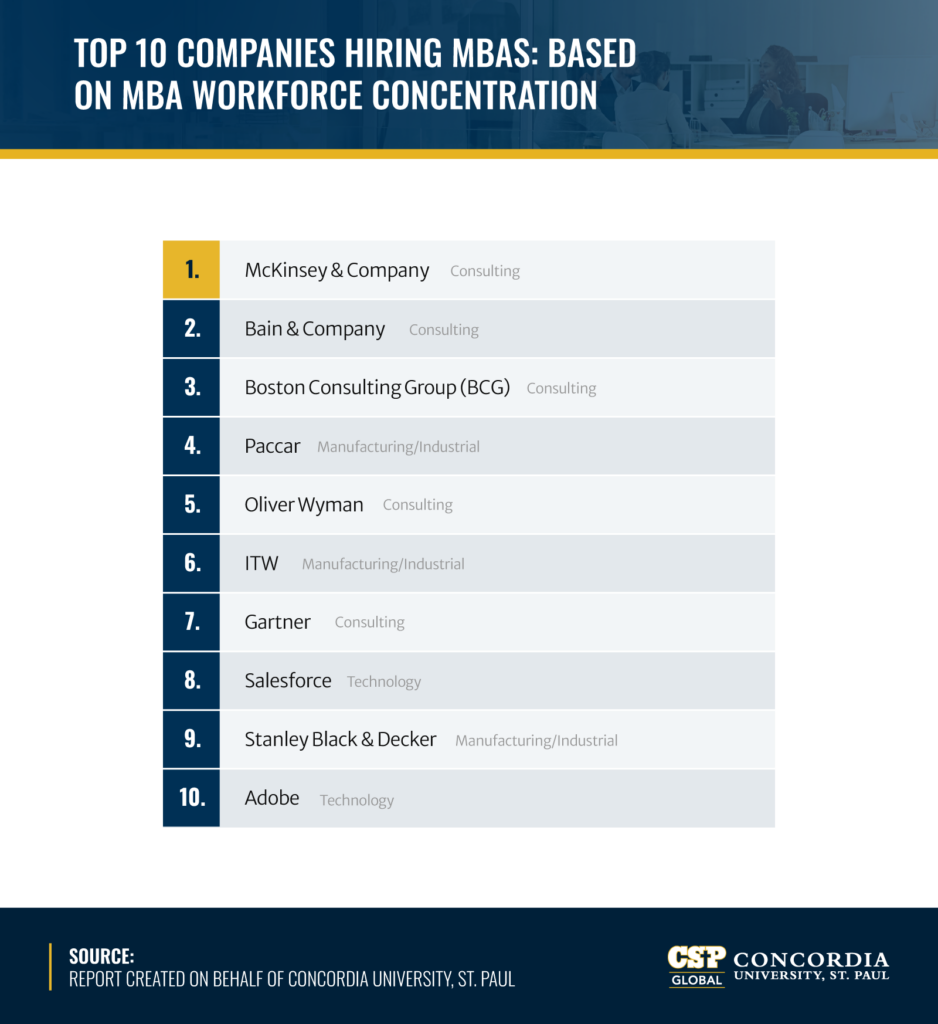
Consulting firms stood out as the clear leaders in the MBA rankings. McKinsey & Company topped the list, with 8.55% of its workforce holding an MBA degree. Bain & Company and Boston Consulting Group also reported that more than 7% of employees listed MBA credentials on their LinkedIn profiles. These firms set the pace for hiring MBA graduates for roles such as strategy consultant and management consultant.
Consulting employed 4.3 times more MBAs than retail companies and 1.8 times more than manufacturing firms. This concentration reflects the strong demand for MBA students trained in problem-solving, analytics, and leadership skills that are central to consulting firms. The top 25 companies hiring MBA talent are:
- McKinsey & Company
- Bain & Company
- Boston Consulting Group (BCG)
- Paccar
- Oliver Wyman
- ITW
- Gartner
- Salesforce
- Stanley Black & Decker
- Adobe
- Vertex Pharmaceuticals
- Guidehouse
- Microsoft
- CBRE
- Amazon
- Deloitte
- Vanguard
- BNY
- State Street Corporation
- Biogen
- American Express
- EY-Parthenon
- RTX Corporation (formerly Raytheon Technologies)
- BlackRock
- Capital One
By contrast, several large consumer and retail employers showed the lowest concentration of MBAs in their workforce. The bottom 20, those with the fewest MBA hires, include:
120. Dollar General (consumer goods/retail): 0.03%
119. Dollar Tree (consumer goods/retail): 0.05%
118. McDonald’s (consumer goods/retail): 0.12%
117. Costco (consumer goods/retail): 0.13%
116. Starbucks (consumer goods/retail): 0.21%
115. Best Buy (consumer goods/retail): 0.22%
114. Tyson Foods (consumer goods/retail): 0.24%
113. Lowe’s (consumer goods/retail): 0.25%
112. Kellogg (consumer goods/retail): 0.27%
111. TJX Companies (consumer goods/retail): 0.28%
110. The Home Depot (consumer goods/retail): 0.29%
109. Texas Instruments (technology): 0.29%
108. AMD (technology): 0.29%
107. Target (consumer goods/retail): 0.33%
106. Jacobs (consulting): 0.33%
105. SAIC (consulting): 0.35%
104. Broadcom (technology): 0.36%
103. General Electric (manufacturing/industrial): 0.38%
102. Walmart (consumer goods/retail): 0.40%
101. Sysco (consumer goods/retail): 0.40%
After consulting, technology was the industry with the most MBA graduates fulfilling roles. The top 15 tech companies hiring professionals with an MBA include the following:
- Salesforce
- Adobe
- Microsoft
- Amazon
- Cisco
- Netflix
- Oracle
- PayPal
- Dell
- Meta
- Apple
- IBM
- Motorola Solutions
- HP
Industries That Pay MBA Graduates the Most
Hiring volume does not always align with salary outcomes. Some industries employ fewer MBA graduates yet offer substantially higher median wages for professionals.
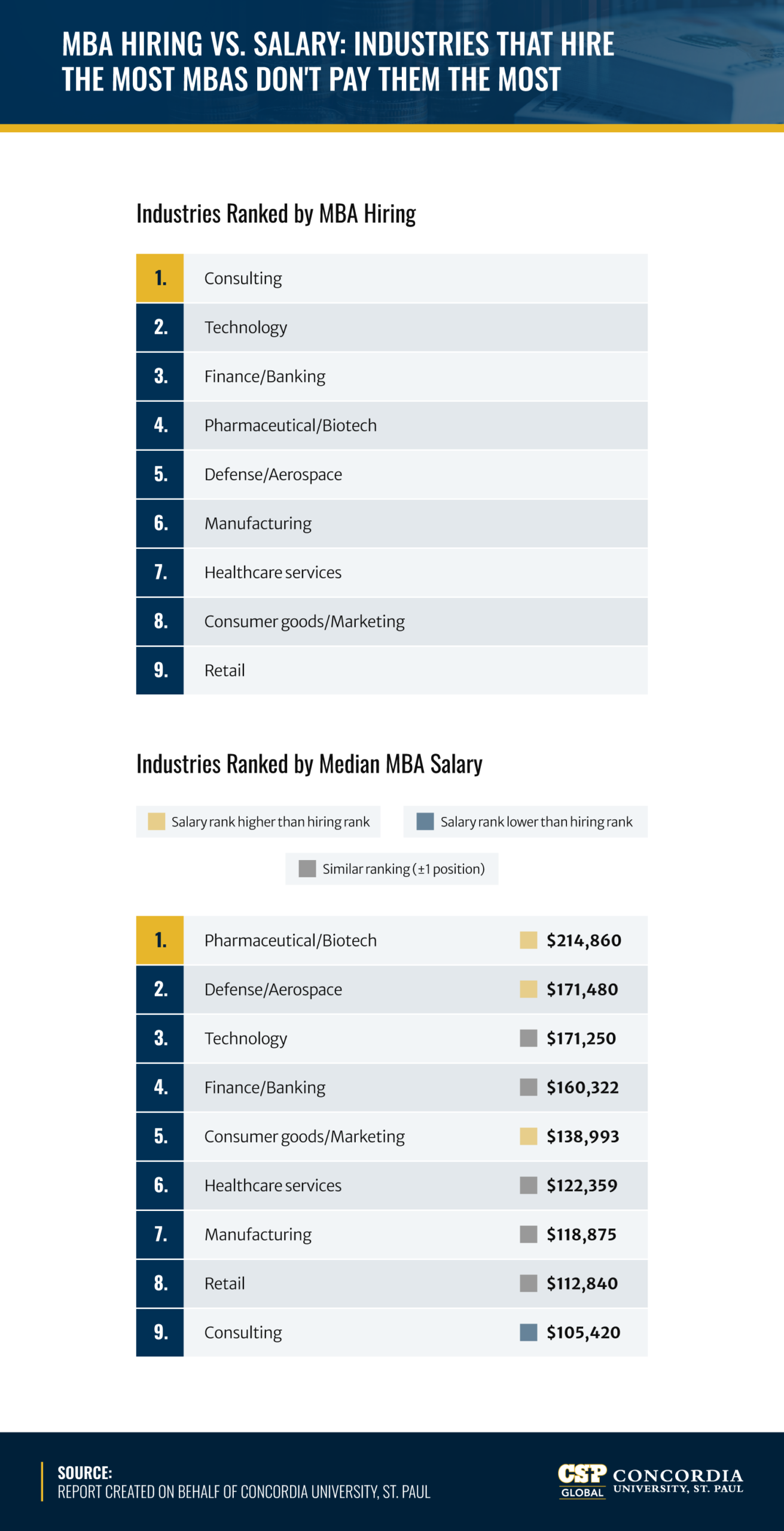
Pharmaceutical and biotech organizations offered the highest pay among the industries analyzed, at $214,860. Median annual wages in this sector were $109,440 higher than consulting ($105,420), more than doubling consulting salaries despite consulting leading in MBA hiring rates. For MBA graduates and others interested in healthcare innovation, the compensation premium is significant.
Finance and banking provided a strong balance between hiring rate and salary. With an average MBA hiring rate of 1.06% and median annual wages of $160,322 for typical MBA roles, the sector stood out to professionals interested in investment banking, financial services, or roles at institutions such as JPMorgan Chase and Goldman Sachs. For MBA students comparing post-MBA paths, finance offers both competitive pay and meaningful representation in large firms.
What MBA Hiring Trends Mean for Today’s Professionals
MBA hiring patterns varied significantly by industry. Consulting firms led in overall concentration, particularly in strategy consulting roles often associated with major markets like New York, while pharmaceutical and biotech organizations in healthcare offered the highest median salaries. Financial services stood out for combining competitive pay with steady MBA representation across large employers. These differences suggest that career outcomes after MBA programs depend heavily on industry selection rather than degree title alone.
For MBA students exploring top MBA programs, clarity about long-term goals is essential. Some professionals may pursue full-time roles in consulting or financial services, while others balance part-time advancement or consider an executive MBA to move into leadership positions within healthcare or corporate settings. Entrepreneurs aiming to launch a startup may evaluate industries differently than those targeting established firms. Understanding where hiring occurs and how compensation varies can help prospective students align their education with realistic, data-informed career paths.
Methodology
This analysis was conducted on behalf of Concordia University, St. Paul using 2026 LinkedIn workforce data and BLS salary information (May 2024). LinkedIn data reflects only employees with profiles who list their MBA degree. BLS data represents occupations, not MBA-holders specifically, with occupation used as a proxy for typical MBA roles.
- MBA Hiring Analysis — Data source: LinkedIn workforce data
- Analyzed 120 major U.S. companies across 9 industries (consulting, technology, finance/banking, pharmaceutical/biotech, healthcare services/insurance, defense/aerospace, manufacturing/industrial, consumer goods/marketing, retail)
- Identified employees listing MBA degrees on LinkedIn profiles
- Calculated MBA percentage: (Total MBAs / Total Employees) × 100
- Industry hiring rates calculated as average MBA percentage across companies in each industry
- Salary Analysis — Data source: BLS OEWS (May 2024)
- Selected typical MBA occupations for each industry (e.g., management analysts in consulting, financial managers in finance/banking, IT systems managers in technology)
- Used industry-specific median annual wages (A_MEDIAN) from BLS
- For industries spanning multiple NAICS codes, calculated employment-weighted averages
Data was collected in February 2026. Findings are specific to the 120 companies and 9 industries analyzed.
About Concordia University, St. Paul
Concordia University, St. Paul offers flexible, career-focused business education designed for working professionals. CSP Global’s online MBA program equips students with practical leadership, strategy and problem-solving skills aligned with today’s job market. Housed within a respected school of business, the program supports MBA students pursuing advancement in consulting firms, financial services, healthcare, entrepreneurship and other high-growth industries. With options suited for full-time and part-time learners, CSP Global prepares graduates for meaningful post-MBA careers.
Fair Use Statement
The information in this article may be used for noncommercial purposes only. If shared, please provide proper attribution and include a link to Concordia University, St. Paul.