
The MBA Money Tracker: How Students Are Funding Business Degrees in 2026
6 Min Read

Graduate business education continues to open doors to leadership roles and higher earning potential. In 2026, however, rising tuition costs and shifting workplace benefits are changing how young professionals pursue an MBA. Many Gen Z and millennial students balance full-time work while building plans to pay for their degrees. To better understand these trends, a questionnaire conducted on behalf of Concordia University, St. Paul (CSP Global) surveyed working professionals about how they are funding their MBA.
This questionnaire was designed to learn how aspiring MBA students manage costs while advancing their careers. Most rely on multiple funding sources, set clear limits on debt and depend heavily on employer support. The questionnaire results also point to the growing importance of flexible online programs that allow students to continue earning income while completing graduate study.
Key Takeaways
- 82% of MBA students are creating personalized “funding stacks” combining work income, employer support, loans and savings to make their degree possible.
- 86% of professionals would not, or might not, pursue an MBA if they had to stop working, making flexible online programs essential to accessing graduate business education.
- 53% of MBA students have tapped funding sources their parents never had, including creator income, fintech micro-savings, crypto gains and tuition-share programs.
- 65% of professionals would stay at a company two or more years longer if it helped fund their MBA, revealing a powerful retention lever for employers.
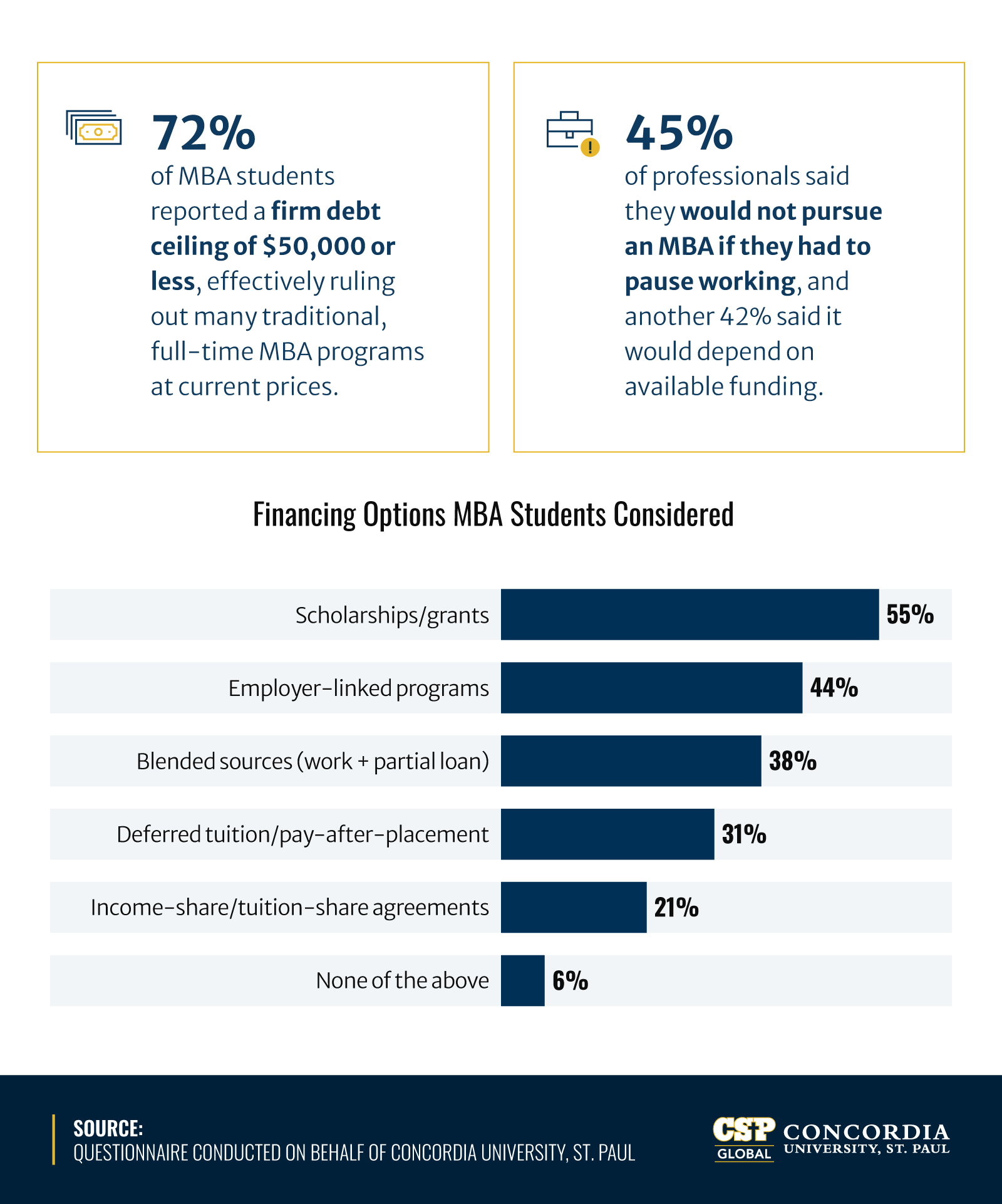
- 72% of MBA students said they are unwilling to take on more than $50,000 in debt to earn an MBA.
MBA Students Are Combining Multiple Funding Sources
Today’s MBA students are not relying on a single payment method. Instead, they are building layered financial strategies that blend income, savings and institutional support.
More than four in five respondents (82%) reported using two or more funding sources to pay for their degree. When asked which sources contributed “quite a bit” or “very much,” current income while working ranked highest at 36%, followed by:
- Personal savings: 35%
- Federal or government loans: 31%
- Employer tuition assistance: 28%
- Scholarships or grants: 24%
Family or partner support (21%), private loans (16%), side income such as freelance or creator work (14%), tuition-share agreements (10%), and equity or asset proceeds (9%) were also part of many funding stacks.
Over half of MBA students (53%) said they have used funding sources their parents never had access to, including creator income, fintech micro-savings, crypto gains and tuition-share programs. Men were more likely than women to use these new-generation funding sources (60% vs. 46%). Generational differences were pronounced:
- Gen Z respondents were less likely than millennials to rely heavily on personal savings (21% vs. 39%) or current income (29% vs. 38%).
- Gen Z was more likely than millennials to rate scholarships or grants (35% vs. 20%), federal loans (35% vs. 29%), private loans (26% vs. 13%) and side income (24% vs. 11%) as significant contributors.
Perceived barriers to pursuing an MBA degree also varied. Gen Z more frequently cited upfront tuition or cash flow timing (38%) and uncertainty about total cost (35%) as barriers, compared to millennials (22% for both). Millennials more often cited time to graduation while balancing work (43% vs. 18%) and limited employer assistance (14% vs. 6%).
Employer Education Benefits Are Influencing Career Decisions
Employer-sponsored graduate education benefits are affecting both MBA financing and workforce mobility. Access to these benefits is influencing where professionals choose to work and how long they stay.
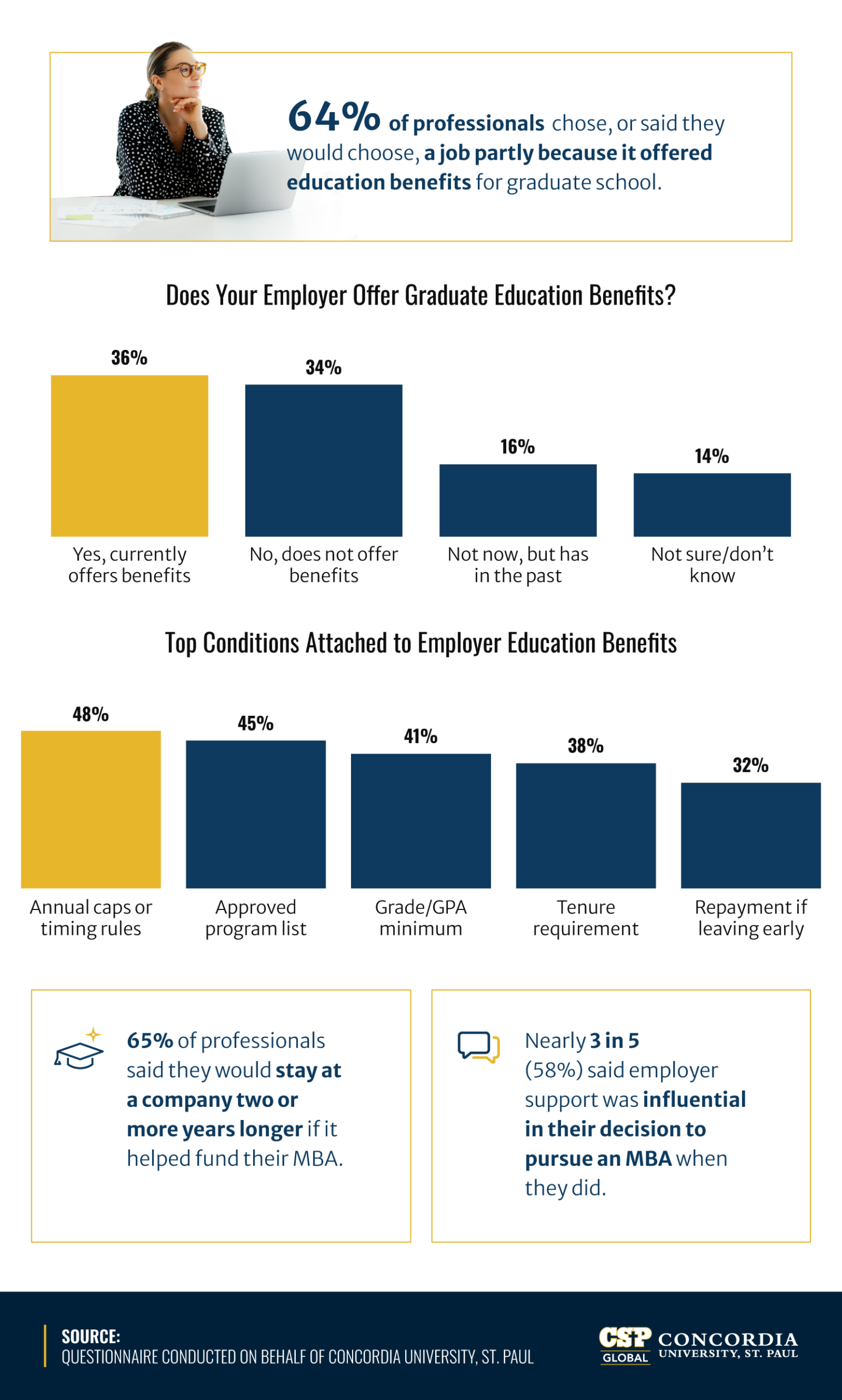
Overall, 36% of respondents reported that their employer currently offers graduate education benefits, while 34% said their employer does not, and 16% said employers offered benefits in the past. Two in five millennials (40%) reported having employer-sponsored graduate benefits compared to 24% of Gen Z respondents.
Employer support was influential in MBA decision-making for 58% of professionals overall, including 59% of millennials and 53% of Gen Z respondents. Many Gen Z respondents (71%) and millennials (62%) said they chose or would choose a job partly because it offered education benefits. Men were more likely than women to make job decisions based on education benefits (68% vs. 62%).
Tuition reimbursement was the most appealing employer benefit for both millennials (57%) and Gen Z (44%). However, employer benefits often come with conditions. Among those with access to education benefits, the top requirements included:
- Annual caps or timing rules: 48%
- Approved program lists: 45%
- GPA minimums: 41%
- Tenure requirements: 38%
- Repayment clauses if leaving early: 32%
Gender differences were notable among those with employer benefits. Women were more likely to report GPA minimums (50% vs. 26% of men) and approved program lists (53% vs. 30%). Men were more likely to report repayment if leaving the company clauses (43% vs. 22%).
Retention implications are substantial. Nearly two in three professionals (65%) said they would stay at a company two or more years longer if it helped fund their MBA. That figure rose to 68% among Gen Z and hit 64% among millennials.
Debt Ceilings and the Need to Keep Working
Affordability remains central to choosing whether to pursue an MBA for many working professionals. Most young workers are setting firm limits on how much debt they are willing to take on.
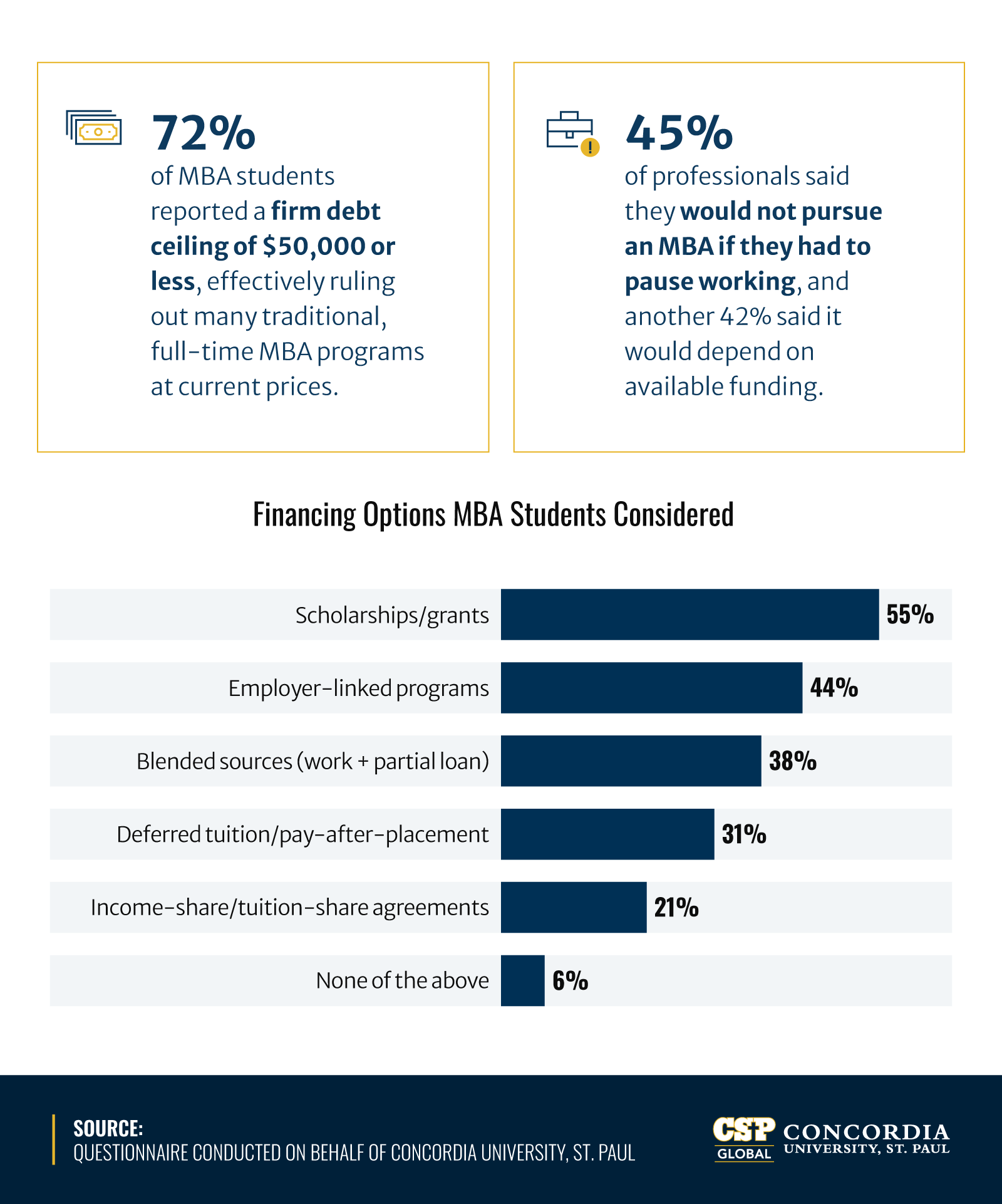
More than seven in 10 millennials (72%) and Gen Z respondents (71%) reported a debt ceiling of $50,000 or less for an MBA. Women were more likely than men to report this limit (74% vs. 68%). Nearly one in five respondents (18%) said they would not or did not use any debt at all to fund their MBA.
The ability to continue working was critical. Over four in five men (87%) and women (85%) said they would not or might not pursue an MBA if they had to pause working. In total, 86% of professionals indicated they would reconsider, or it would depend on available funding, if they had to stop working.
When evaluating financing options, respondents most often considered:
- Scholarships or grants: 55%
- Employer-linked programs: 44%
- Blended sources combining work and partial loans: 38%
- Deferred tuition or pay-after-placement models: 31%
- Income-share or tuition-share agreements: 21%
Gen Z (38%) was more than twice as likely as millennials (17%) to consider income-share or tuition-share agreements, which allow students to repay tuition as a percentage of future earnings or through delayed payment models. They were also more likely to consider blended funding approaches that combine income, loans and other sources (47% vs. 35%) but less likely to consider employer-linked programs (26% vs. 48%).
A New Blueprint for Business Education Funding
Current and prospective MBA students are approaching graduate education with financial discipline and strategic planning. Most are building funding stacks that combine work income, employer support and carefully managed debt. Clear debt ceilings and strong resistance to pausing employment underscore the importance of flexible program design.
Employer-sponsored education benefits are influencing both enrollment decisions and long-term retention, while alternative financing models are expanding options for younger professionals. As affordability continues to shape the national conversation, online MBA programs are helping working adults advance without stepping away from their careers.
Methodology
A questionnaire was administered to 154 working professionals on behalf of Concordia University, St. Paul to explore how MBA students and prospective students fund their degrees, including their funding sources, debt tolerance, employer support and financial barriers. Respondents were sourced using CloudResearch Connect.
The average age of respondents was 34; 53% were women, 44% were men and 2% were nonbinary. In addition, 78% were millennials and 22% were Gen Z. Some percentages in this study may not total 100% due to rounding. This was a non-scientific, exploratory questionnaire designed to explore behavioral and attitudinal trends. The results are not intended to represent all working professionals.
About Concordia University, St. Paul
Concordia University, St. Paul offers online programs designed for working adults who want flexible options that fit around career and family responsibilities. Students can explore a wide range of academic pathways, including business programs that support skill development for leadership roles. Professionals interested in building their skills can explore CSP Global’s online MBA programs today.
Fair Use Statement
You may use the information in this article for noncommercial purposes only. If you share it, please include proper attribution and a link back to Concordia University, St. Paul.