
The Most Educated U.S. States and Cities
4 Min Read

Where you live can impact your career advancement and earning potential. A report based on U.S. Census Bureau data was created on behalf of Concordia University, St. Paul (CSP Global) to identify which states and cities have the highest percentages of adults with bachelor’s and graduate degrees. The results reveal dramatic gaps. In some areas, over 40% of adults hold bachelor’s degrees, while in others, fewer than 15% do.
Regions with higher educational attainment typically offer more opportunities for degree holders, including better-paying jobs, stronger professional networks and greater access to continuing education. If you’re in a market where relatively few adults have degrees, earning yours could give you a significant competitive advantage. If you’re in a highly educated area, advancing to a graduate degree may be essential to stand out. Understanding these patterns can help you make strategic decisions about your education and career path, whether you’re pursuing your first degree or considering going back for an advanced credential.
Key Takeaways
- Colorado has the most adults with bachelor’s degrees (29%), followed by New Jersey (26.4%) and Minnesota (26%).
- Massachusetts (22.6%), Maryland (21.5%) and Connecticut (19.3%) have the most graduate degree holders in the U.S.
- West Virginia is the least college-educated state, with 14.8% of adults age 25 or older holding bachelor’s degrees and 9.6% with graduate or professional degrees.
- Irvine, California, is the city with the highest prevalence of bachelor’s degrees (40%).
- Santa Ana, California, has the lowest percentage of graduate degrees (4.9%).
States With the Highest Levels of Educational Attainment
States play a critical role in shaping access to education through policy, funding and workforce demand. Examining statewide attainment reveals how regional economies and academic ecosystems may influence degree completion at both the undergraduate and graduate levels.
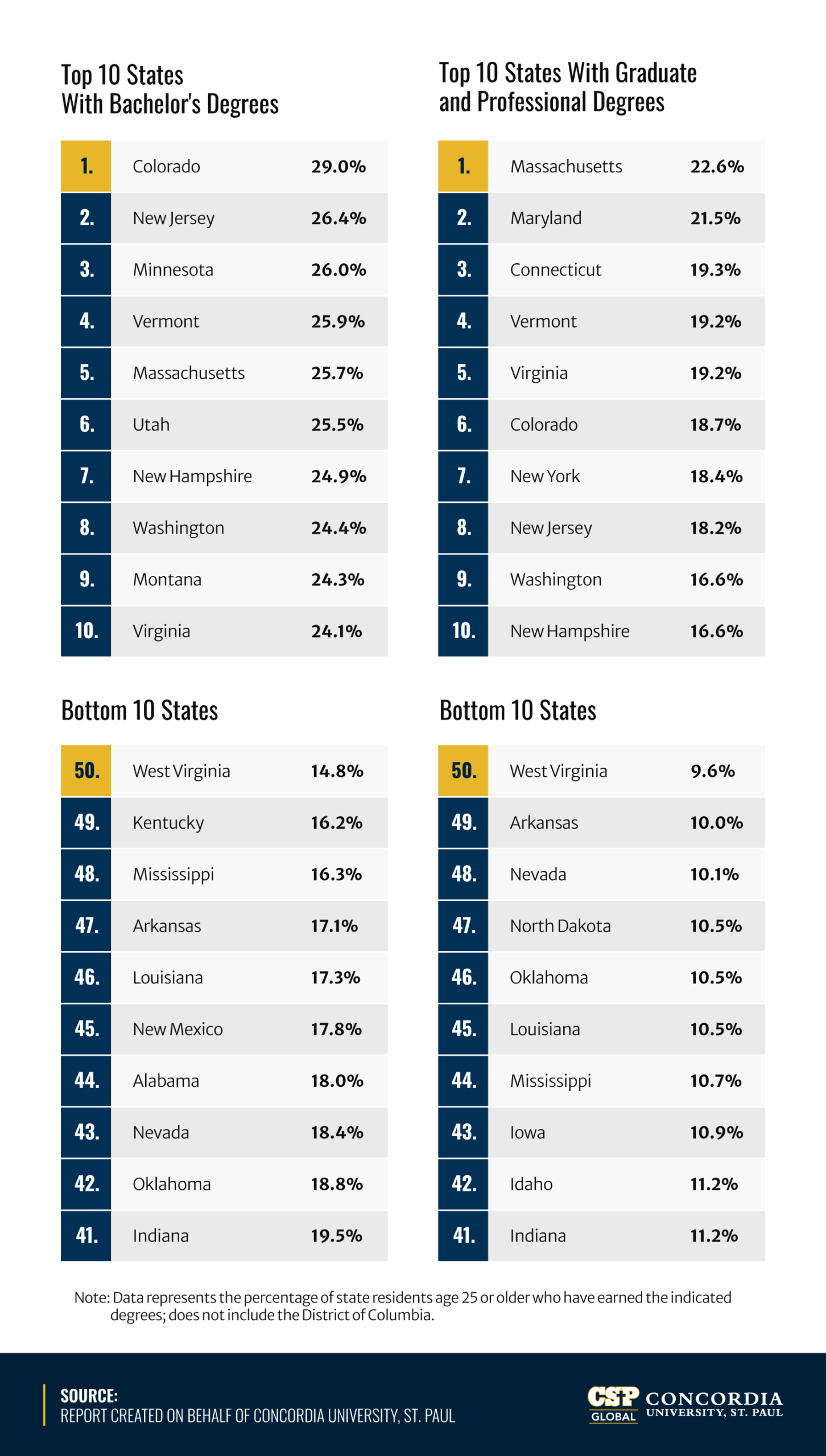
Massachusetts ranked highest for graduate degree attainment, with 22.6% of adults holding a master’s, professional, or doctoral degree. Maryland followed closely at 21.5%, while Connecticut ranked third at 19.3%. These states have long benefited from dense networks of colleges, research institutions, and knowledge-based industries that support advanced education.
At the bachelor’s level, Colorado ranked first in the nation, with 29% of adults holding a bachelor’s degree. In contrast, West Virginia ranked lowest, with only 14.8% of adults holding a bachelor’s degree, underscoring persistent barriers to degree attainment in some regions.
The Most Educated Cities
City-level data highlighted even sharper contrasts in educational attainment. Urban areas often reflect local industry needs, migration patterns, and access to higher education institutions, resulting in significant variation from one city to another.
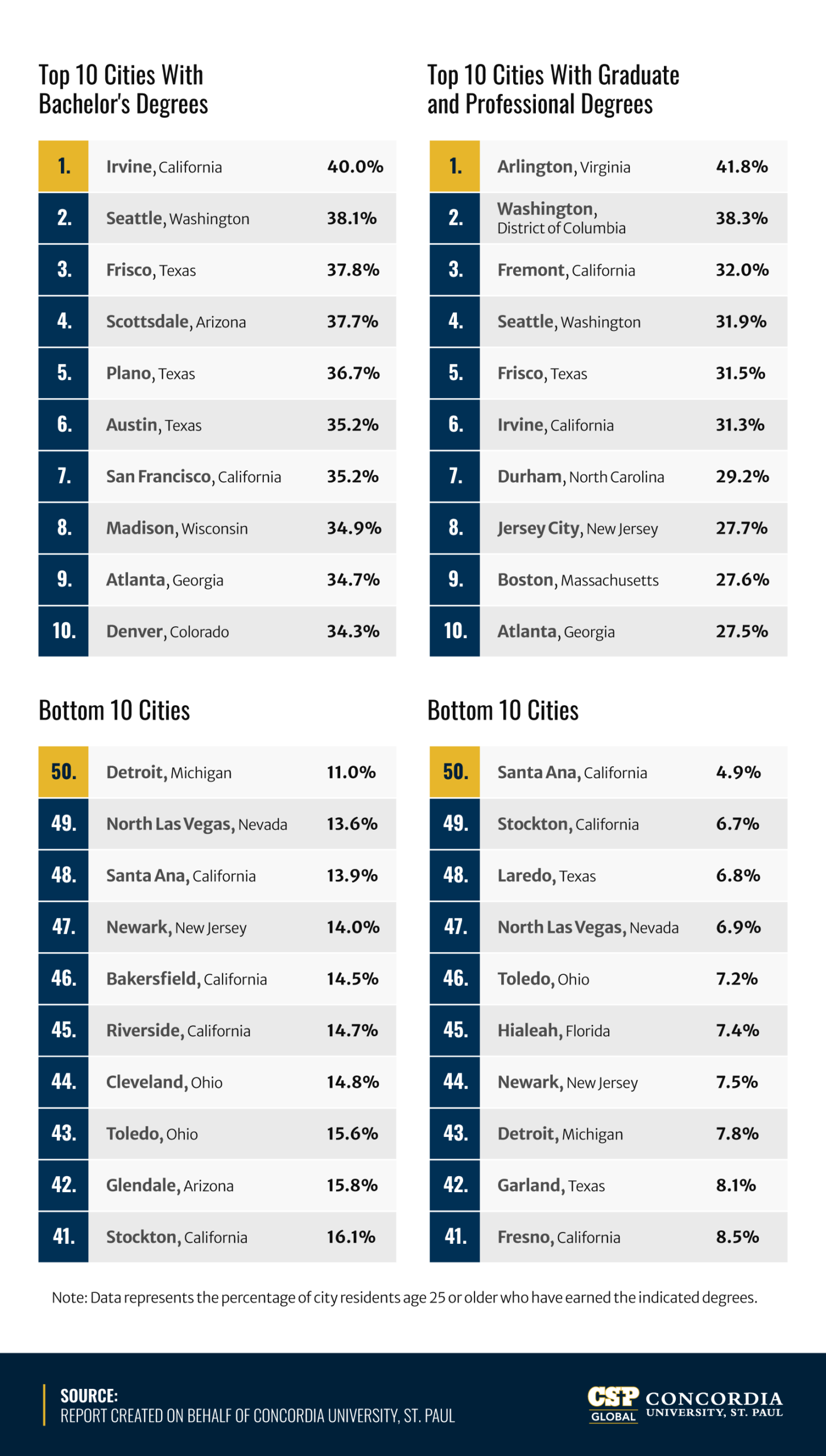
Irvine, California, reported the highest prevalence of bachelor’s degrees, with 40% of adults holding at least a four-year degree. Arlington, Virginia, stood out for advanced education, with 41.8% of adults holding graduate or professional degrees, the highest share among large cities analyzed.
Other cities showed substantially lower attainment. Detroit, Michigan, reported 11% of adults holding a bachelor’s degree, followed by North Las Vegas, Nevada, at 13.6%, and Santa Ana, California, at 13.9%. Santa Ana also ranked lowest for graduate degree attainment, with only 4.9% of adults holding an advanced degree.
What This Means for Your Educational Journey
These rankings reflect real differences in job markets, salary expectations and professional opportunities across the country. The concentration of degree holders in your area influences everything from the types of positions available to the credentials employers expect from candidates. Recognizing these patterns helps you assess whether earning or advancing your degree aligns with your career goals and local market conditions.
For adult learners balancing work and education, this data provides valuable context for informed decision-making. Whether you’re looking to increase your earning potential, qualify for a promotion or change careers entirely, understanding your region’s educational profile can guide your next steps. The investment in your education becomes more strategic when you know how it positions you within your local workforce.
Methodology
This report was created on behalf of Concordia University, St. Paul. Rankings are based on the most recent American Community Survey (ACS) Table S1501. “Most educated” is defined as the percentage of residents ages 25 and older with a bachelor’s degree or higher. Graduate and professional degree attainment is analyzed as a secondary metric. State rankings include all 50 states. City rankings include incorporated places with a population of at least 100,000. Data reflects the 2024 American Community Survey 1-Year Estimates.
About Concordia University, St. Paul
Concordia University, St. Paul understands the challenges adult learners face when pursuing higher education. CSP Global’s online degree programs are designed specifically for working professionals who need flexibility without sacrificing quality. With competitive tuition, generous transfer credit policies, and accelerated courses, CSP Global makes it possible to earn your degree while managing your career and personal responsibilities.
Fair Use Statement
The information presented in this article may be used for noncommercial purposes only. When sharing or referencing this content, you must provide proper attribution and a link to Concordia University, St. Paul.