
How Midcareer Professionals Are Secretly Earning Their MBAs
6 Min Read

Ambition does not always announce itself. Across industries, midcareer professionals are quietly preparing for their next move by enrolling in Master of Business Administration (MBA) programs without telling their employers. For working adults balancing careers and personal responsibilities, discretion can feel like a strategic choice in a competitive job market.
A questionnaire was administered to 122 midcareer professionals on behalf of Concordia University, St. Paul (CSP Global) to explore why they pursue online MBAs, including their motivations, sacrifices, and strategies for balancing work and coursework. This research aimed to better understand the “quiet ambition” movement and how online graduate education fits into the lives of experienced workers.
Key Takeaways
- 54% of professionals have pursued their MBA in secret, never telling their manager.
- More than one in 10 professionals (14%) have completed coursework during work hours without their manager knowing.
- 19% of professionals worry about being labeled a “flight risk” if discovered.
- Personal growth (84%) outranks higher pay (80%) as the top motivation for pursuing an MBA.
- While working full-time, 50% of professionals have given up sleep to make time for their MBA.
- 81% of accepted students have kept their MBA secret, compared to just 38% of MBA graduates.
Why Professionals Keep Their MBAs a Secret
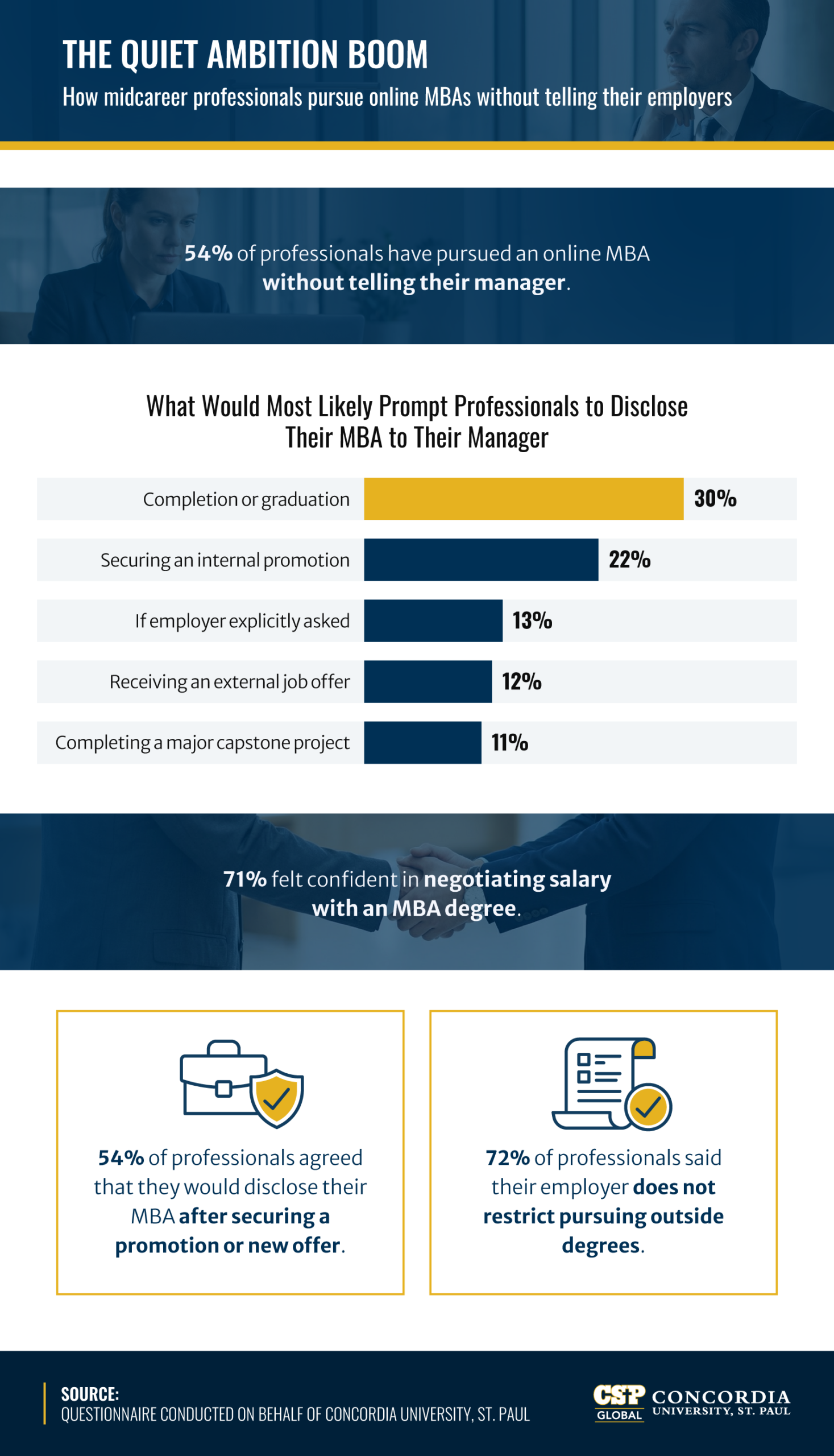
- 81% of accepted students have kept their MBA secret, compared to 70% of currently enrolled students (70%) and even fewer MBA graduates (38%). Gen Z professionals are the most likely to keep their MBA secret (69%), compared to Gen X (55%) and millennials (51%).
- While most employers do not restrict pursuing outside degrees, 16% of professionals are unsure whether their employer has a relevant policy. Another 9% have a policy restricting degrees or education from outside the employer, and 3% require disclosure or approval to pursue a degree.
- 54% of professionals view an MBA degree primarily as a signal or credential rather than as new knowledge.
- 20% believe their employer would react negatively if they found out about their MBA, but only 2% of professionals plan never to disclose their MBA. A few (6%) said their annual performance review would prompt disclosure.
Who MBA Graduates Told About Their Degree
- 46% of professionals told their manager and/or their team about their MBA.
- 37% did not tell their manager or close colleagues about their MBA.
- 17% told one trusted colleague but not their manager.
Why MBA Grads Kept Their Degree Pursuit Quiet
- 22% of professionals kept their MBA private to avoid negative assumptions about their commitment to their current role.
- 8% kept their MBA private to keep future options open without internal pressure.
- 8% preferred to keep work and education separate.
- 5% wanted to reduce workplace gossip or scrutiny.
- 3% feared jeopardizing promotion or raise prospects.
What Worries Professionals Pursuing an MBA
- 41% of professionals are very or extremely concerned about financial strain from tuition and opportunity costs.
- 32% report high concern about burnout or health impacts.
- 32% worry about being perceived by their employer as lacking commitment.
- 30% are highly concerned about scheduling conflicts with classes and exams.
- 20% highly concerned about colleague resentment if their MBA is revealed later.
- 19% fear their manager could block future opportunities.
- 19% worry about being labeled a “flight risk” if discovered.
- 18% are concerned about a negative impact on performance reviews.
What Drives Midcareer Professionals to Pursue an MBA
- Personal growth and achievement: 84%
- Increasing earning potential: 80%
- Building leadership and management skills: 74%
- Qualifying for senior or executive roles: 69%
- Strengthening strategic and financial acumen: 59%
- Future-proofing their career: 58%
- Expanding their professional network: 55%
- Maintaining relevance as younger talent advances: 50%
What Professionals Plan to Do in the Next 12-24 Months
- Seek a promotion at their current company: 42%
- Remain in their current role: 38%
- Switch roles within their current company: 25%
- Move to a new company in the same industry: 19%
- Start their own company: 16%
Demographic Highlights
- 67% of accepted students report high financial strain concerns, compared to 33% of graduates.
- Women are more concerned about financial strain than men (48% vs. 35%).
- Women rate personal growth as a very or extremely important driver to earning an MBA at a higher rate than men (88% vs. 81%).
- Millennials (86%) rate earning potential importance higher than Gen X (72%) and Gen Z (69%).
- Gen X professionals are the most confident negotiating salary with their degree (86%), compared to Gen Z (69%) and millennials (66%).
How Professionals Balance Work, Life and Coursework
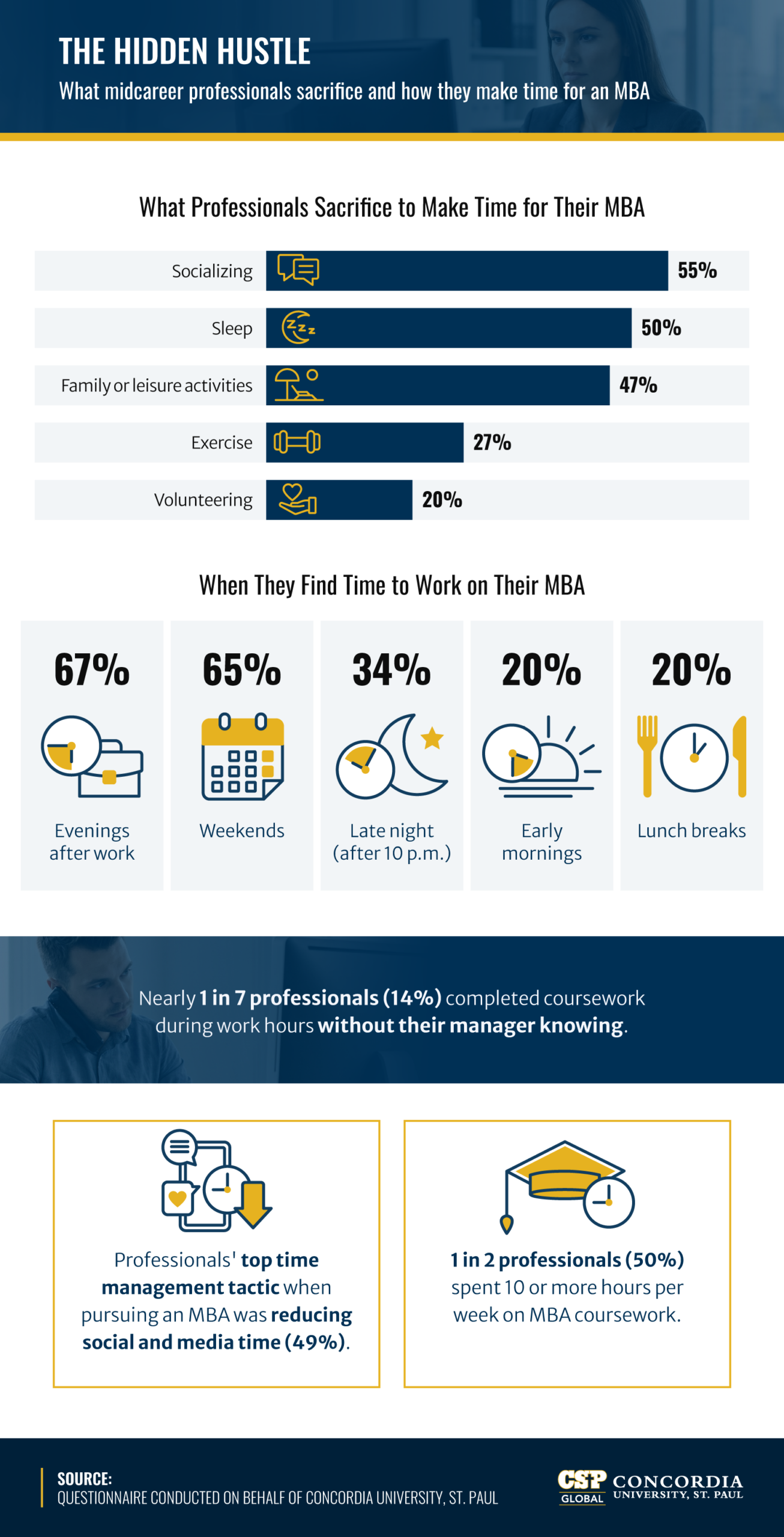
- 40% of professionals spend five to nine hours per week on coursework, while 36% spend 10 to 14 hours. Women spend 10 or more hours per week on coursework at a higher rate than men (56% vs. 46%).
- 52% of professionals take two courses per term, 25% take three and 13% take four.
- 13% use paid time off for coursework, while 5% study during work hours with their manager’s awareness. Gen X professionals are the most likely to study late at night (41%), compared to Gen Z (38%) and millennials (31%). Women are more likely than men to study during work hours without their manager knowing (20% vs. 8%).
- Millennials are the most likely to cut back on sleep to make time for their MBA (62%), compared with Gen X (31%) and Gen Z (25%). They’re also more likely to reduce socializing, with 60% of millennials cutting back compared to Gen X (55%) and Gen Z (31%).
- Gen Z professionals are the most likely to leverage AI tools to keep up with coursework (25%), compared with Gen X (17%) and millennials (14%).
What Else Midcareer Professionals Have Sacrificed or Limited for an MBA
- Professional development unrelated to their MBA: 16%
- Childcare or caregiving responsibilities: 12%
- Career networking: 10%
How They Make It Work
- Use batch-working or study sprints: 30%
- Rely on study groups or accountability partners: 30%
- Block calendars for “focus time” or “meetings”: 28%
- Delegate household tasks: 23%
- Leverage AI tools (e.g., summarizers): 16%
- Negotiate flexible hours or remote days without disclosing the reason: 15%
- Use productivity apps (e.g., Notion, Trello): 14%
Was It Worth It?
- 72% of professionals rate the value of their MBA at or above expectations, 26% rate it higher than expected and only 14% rate it lower than expected.
- 91% of currently enrolled students rate the MBA value at or above expectations, compared to 79% of graduates.
Methodology
A questionnaire of 122 working professionals was conducted on behalf of CSP Global to explore how midcareer professionals pursued online MBAs without their employers’ knowledge, including their motivations, sacrifices and strategies for balancing work and coursework. Respondents were sourced using CloudResearch Connect. The average age of respondents was 39; 46% were women, 53% were men and 1% were nonbinary. This was a non-scientific, exploratory questionnaire designed to explore behavioral and attitudinal trends. It is not intended to represent all midcareer professionals with an MBA.
About Concordia University, St. Paul
Concordia University, St. Paul offers online programs designed for working adults who want flexible options that fit around career and family responsibilities. Students can explore a wide range of academic pathways, including business programs that support skill development for leadership roles. Professionals interested in building employer-aligned skills can explore CSP Global’s online MBA programs today.
Fair Use Statement
You may use the information in this article for noncommercial purposes only. If you share it, please include proper attribution and a link back to Concordia University, St. Paul.